Why Does My Child Spin Constantly?
- Shahram Ariafar
- Apr 20
- 6 min read

Updated: Apr 29
A child who spins over and over in the classroom, at home, or on the playground can draw quick attention. Adults may wonder, why does my child spin constantly, and is this a sign of a problem, a sensory need, or simply a preferred way to play? The most helpful starting point is to look beyond the behavior itself. Spinning is not just movement. It can be communication, regulation, exploration, or a response to an environment that feels too intense or not intense enough.
Why does my child spin constantly? Start with the function
When a child spins frequently, the key question is not whether spinning is good or bad. The key question is what the spinning is doing for that child. In practice, spinning often serves a function. It may help the child wake up their body, organize sensory input, manage stress, or create a predictable sensation in an unpredictable environment.
For some children, spinning is part of typical development. Young children often experiment with movement because it is pleasurable and informative. They are learning where their body is in space, how balance works, and how different movements feel. A preschooler who spins, laughs, falls down, and gets back up may simply be exploring.
For other children, especially those with sensory processing differences, autism, ADHD, developmental delays, or high stress levels, spinning may happen more often and with greater intensity. In those cases, it can be a meaningful clue. Not necessarily a red flag, but a clue that the child may need support with regulation, body awareness, or environmental adaptation.
What spinning can mean in real settings
The vestibular system, which helps us process movement and balance, is often part of the picture. Some children seek strong vestibular input because it helps them feel more alert, grounded, or organized. Spinning can give intense sensory feedback very quickly. For a child who is under-responsive to movement input, that sensation may feel satisfying and stabilizing.
At other times, spinning is less about sensory seeking and more about coping. A child may spin during noisy transitions, in crowded spaces, or when demands increase. In that context, the movement may reduce distress by narrowing attention onto a familiar body-based experience. Repetition can create predictability, and predictability supports emotional safety.
There is also a social and communicative layer to consider. Some children spin when they are excited, waiting, frustrated, or unable to express a need. If the child does not yet have strong spoken language or reliable self-advocacy skills, movement may become part of how they communicate internal states.
This is why context matters so much. A child who spins briefly during free play presents a different picture from a child who spins through instruction, misses peer interaction, becomes dizzy and dysregulated, or cannot stop without adult help.
When spinning is usually part of development
Spinning is often less concerning when it is flexible, brief, and connected to play. The child can stop when called, shift into another activity, and stay engaged in daily routines. They are not distressed by the movement, and the spinning does not consistently interfere with learning, safety, sleep, or social participation.
In these cases, adults may still want to observe patterns, but the response does not need to be alarmed. Children use movement to learn. Some need more of it than others.
When it deserves a closer look
The question why does my child spin constantly becomes more important when the behavior is intense, frequent, or hard to interrupt. It also deserves attention when spinning appears alongside motion insensitivity, frequent crashing, constant movement seeking, communication challenges, emotional overwhelm, or difficulty participating in group learning.
A closer look is also warranted if the child spins to the point of falling, colliding with furniture, seeming unaware of danger, or becoming more dysregulated afterward. Some children look energized by spinning in the moment but then struggle to settle, attend, or transition. Others may use spinning so often that it replaces broader play and learning experiences.
None of this automatically points to one diagnosis. It simply tells us the behavior may be carrying more weight than simple play.
What professionals should observe before reacting
In schools, therapy spaces, and care settings, adults often jump too quickly from behavior to interpretation. A more effective approach is structured observation. Notice when the spinning happens, how long it lasts, what happens right before it starts, and what changes after it ends.
Ask whether the child spins during transitions, waiting periods, loud group activities, or unstructured time. Observe whether they seek other intense movement such as jumping, hanging upside down, rocking, or running in circles. Pay attention to facial expression, breathing, vocalizations, and recovery time. A child who spins while smiling and inviting others into play is communicating something different from a child who spins with tension, withdrawal, or distress.
This kind of observation helps teams avoid two common mistakes. The first is treating all spinning as a behavior problem. The second is assuming all spinning is harmless sensory play. Both can lead to missed support.
Support strategies that respect regulation needs
If spinning appears to serve a sensory or regulatory purpose, the goal is not to eliminate movement. The goal is to help the child access regulation, participation, and safety in more supported ways.
Begin by considering whether the environment is asking too much of the child’s nervous system. Fluorescent lighting, crowding, noise, visual clutter, and rapid transitions can all increase movement-based coping. Reducing stressors may lower the need for constant spinning.
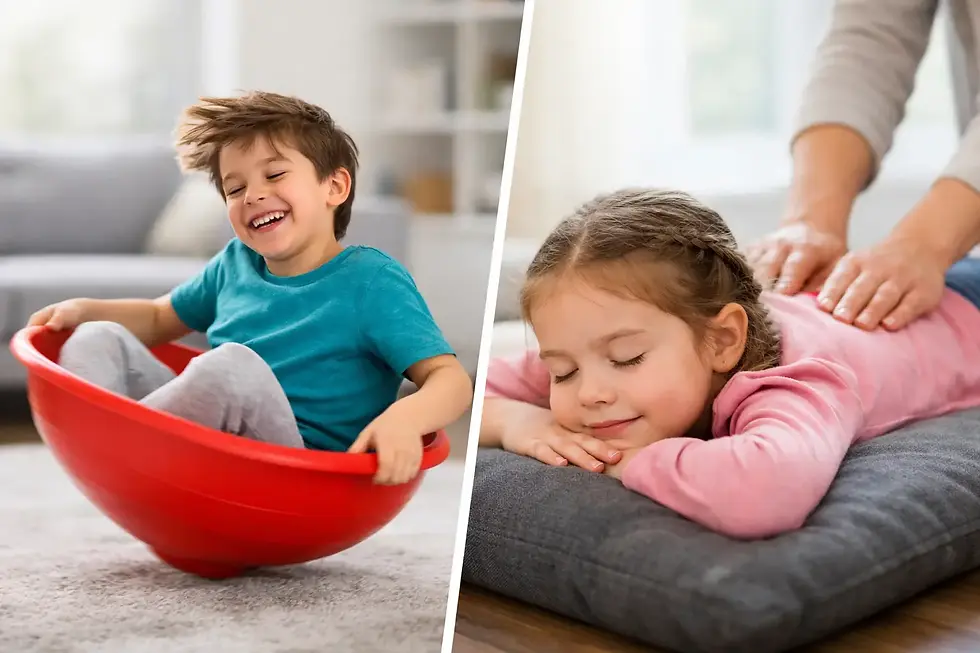
Next, build in intentional movement opportunities across the day. Many children do better when strong sensory input is offered proactively rather than only after dysregulation appears. This might include scheduled movement breaks, heavy work, obstacle courses, floor-based activities, pushing and pulling tasks, or guided vestibular play with supervision. The right choice depends on the child. Some children become more organized with movement. Others become more activated. That is why individualized response matters.
Language also matters. Instead of saying, “Stop spinning,” adults can try, “Your body needs movement. Let’s find a safe way,” or, “First we help your body get organized, then we return to the table.” This preserves dignity while teaching regulation.
Visual supports, predictable routines, and clear transition cues can also reduce repetitive spinning that is linked to uncertainty. A child who knows what is happening next often has less need to create predictability through repetitive movement.
Why does my child spin constantly at school but not at home?
This pattern is common and often very informative. School environments place different demands on attention, sensory processing, communication, and social navigation. A child may hold themselves together for part of the day and then use spinning when the effort becomes too great. Another child may spin more at school because the environment is more stimulating, less predictable, or less physically accommodating.
Home and school should not compete over which picture is the real one. Both are real. The child is responding to context. When families and professionals compare patterns without judgment, they often identify practical adjustments more quickly.
When to involve an occupational therapist or developmental specialist
If spinning is frequent, disruptive, unsafe, or paired with broader concerns about sensory processing, attention, communication, coordination, or emotional regulation, a referral can be very helpful. An occupational therapist can assess how sensory input, motor planning, posture, arousal, and daily participation connect. Other developmental specialists may also be relevant depending on the child’s overall profile.
The purpose of evaluation is not to pathologize movement. It is to understand the child more accurately. Good support begins when adults can tell the difference between a habit, a preference, a regulation strategy, and a sign that the child’s sensory system needs more structured support.
For teams in schools and institutions, this is where professional confidence matters. A sensory-informed approach can shift the response from correction to facilitation. Instead of asking how to stop a child from spinning, we ask how to help that child feel safe, organized, and available for learning.
A more useful question than “How do I make it stop?”
Spinning can be joyful. It can also be a signal that a child is working hard to manage their body and environment. The behavior alone does not tell the whole story. Frequency, context, flexibility, safety, and impact on participation are what give it meaning.
In practice, the most effective support is rarely about stopping the spinning itself. It is about understanding the need underneath it and responding with structure, respect, and appropriate sensory opportunities. That is where children gain more than control. They gain comfort, mastery, and a better chance to engage fully in learning and daily life.
When we stay curious instead of reactive, repetitive movement becomes easier to read, and much easier to support well.
You Are Not Alone – We Are Here to Help
Finally, we want to remind you that you are not alone. Many families, schools, kindergartens, and care institutions face similar challenges—and there are effective solutions. We have extensive experience supporting and guiding others in finding practical, tailored approaches to accommodation, sensory support, and inclusion.
If you would like more concrete support, we encourage you to explore our courses and consultations. Together, we can create a better everyday life.


Comments