
What Are the Eight Different Senses?
- Shahram Ariafar
- Mar 29
- 6 min read

A child covers their ears during circle time, rocks in their chair during math, and avoids the art table because glue on their hands feels unbearable. On paper, those behaviors can look unrelated. In practice, they often point to one central question: what are the eight different senses, and how do they shape learning, regulation, and participation?
For educators, therapists, and support teams, this question matters because sensory processing is not a side issue. It affects attention, body awareness, emotional safety, motor planning, transitions, and a person’s ability to engage with people and tasks. When professionals understand the full sensory picture, they are better able to create environments that support mastery rather than overload.
What are the eight different senses in practice?
Most people learn that humans have five senses: sight, hearing, smell, taste, and touch. That is a useful starting point, but it is not enough for educational or therapeutic work. In practice, we also rely on the vestibular sense, the proprioceptive sense, and interoception.
These three additional senses are especially important when supporting children and adults with sensory processing differences, developmental disabilities, autism, ADHD, complex communication needs, or trauma-related regulation challenges. A learner may see and hear well, yet still struggle to sit upright, judge force, tolerate movement, notice hunger, or feel safe in a busy room. That is why a broader sensory understanding leads to better support.
The first five senses most people know
Sight
The visual system helps us interpret light, movement, contrast, faces, objects, and spatial relationships. In classrooms and care settings, vision supports reading, scanning, imitation, and navigation.
But more visual input is not always better. Busy walls, flickering lights, reflective surfaces, or too many competing materials can increase stress for some learners. Others may seek strong visual input through spinning objects, bright colors, or watching movement. The same environment can calm one person and overwhelm another.
Hearing
The auditory system helps us detect speech, rhythm, volume, pitch, and environmental sounds. It is central to communication, but it also affects arousal and regulation.
For some individuals, a chair scraping across the floor can feel as disruptive as a fire alarm. Others may not register verbal instructions unless language is supported by rhythm, gesture, or visual structure. Auditory processing is not only about whether a person can hear. It is also about how the brain organizes and prioritizes what is heard.
Smell
Olfaction often gets overlooked in professional planning, yet it can have a strong effect on memory, emotion, appetite, and safety. Cleaning products, lunches, perfumes, markers, and sensory room materials all contribute to smell-based experiences.
For a learner with a highly reactive olfactory system, smell can trigger avoidance long before a task begins. For others, familiar scents may support calm and predictability. This is one of the quieter senses, but it can quickly shape a person’s willingness to stay in a space.
Taste
Taste supports more than food preference. It is tied to oral motor development, feeding confidence, exploration, and sensory tolerance.
Some individuals seek strong tastes such as sour, crunchy, or spicy input. Others prefer bland, predictable foods and may reject mixed textures or temperature changes. In schools and institutions, this matters during meals, toothbrushing, speech work, and daily routines that involve oral sensory demands.
Touch
The tactile system gives information about pressure, texture, temperature, pain, and contact with objects or people. It helps with discrimination, boundaries, manipulation of materials, and emotional security.
A learner who avoids finger paint, resists certain clothing, or becomes distressed in crowded lines may be responding to tactile overload. Another may seek touch constantly through grabbing, crashing, or rubbing surfaces. Both patterns tell us something useful. Touch is not simply pleasant or unpleasant. It is deeply connected to safety and participation.
The three additional senses professionals need to know
Vestibular sense
The vestibular system is the sense of movement and balance. It is located in the inner ear and helps the brain understand head position, speed, direction, and gravitational changes. This system supports posture, eye control, bilateral coordination, and a stable sense of where the body is during movement.
When vestibular processing is challenged, a person may avoid swings, stairs, tilting, or uneven surfaces. They may become anxious when their feet leave the ground or appear disorganized during movement. Others strongly seek vestibular input through spinning, rocking, jumping, or hanging upside down.
This is where professional judgment matters. Vestibular input can be organizing for one person and destabilizing for another. Fast spinning, for example, is not automatically helpful just because a learner seeks it. Dosage, timing, and the individual’s regulation profile matter.
Proprioceptive sense
The proprioceptive system gives feedback from muscles and joints about body position, effort, and force. It helps us know where our limbs are without looking, how hard to push, and how much pressure to use.
This sense is often central to regulation. Heavy work, resistance, carrying, pushing, pulling, squeezing, and climbing can provide proprioceptive input that helps many learners feel more organized and grounded. A student who breaks pencils, slams doors, leans heavily on peers, or struggles to grade force may be showing proprioceptive processing needs rather than intentional defiance.
Because proprioceptive input is often calming, professionals sometimes overgeneralize its effects. It helps many people, but not all activities fit all bodies or all moments. The goal is not to add random movement breaks. The goal is to match the input to the learner’s needs and the demands of the setting.
Interoception
Interoception is the sense of the body’s internal signals. It includes awareness of hunger, thirst, pain, temperature, nausea, toileting needs, breathing, and changes linked to emotional states.
This sense has gained more attention in recent years because it plays such a strong role in self-regulation and communication. A person who does not notice early signs of hunger, a full bladder, rising anxiety, or physical discomfort may appear to have sudden behavior changes. In reality, the body may have been signaling for some time without the person recognizing or interpreting those signals clearly.
Interoception also affects emotional literacy. Before someone can use a strategy to regulate, they often need to notice what their body feels like in the first place. That is one reason co-regulation, predictable routines, and body-based teaching are so important.
Why understanding the eight senses changes professional practice
When teams ask what are the eight different senses, they are really asking how to move from observation to effective support. A broader sensory model helps professionals avoid oversimplified explanations such as noncompliance, inattention, or poor motivation.
For example, a learner who cannot remain seated may be seeking vestibular or proprioceptive input. A person who refuses lunch may be reacting to smell, texture, or interoceptive confusion rather than oppositional behavior. A student who melts down during assemblies may be managing visual, auditory, and touch input all at once.
This does not mean every challenge is sensory. Sometimes the issue is communication, trauma, curriculum mismatch, fatigue, pain, or social demand. Often it is a combination. Sensory understanding works best when it is part of a wider, respectful assessment of the whole person.
Supporting the eight senses in schools and care settings
The most effective sensory support is rarely complicated. It is thoughtful, consistent, and linked to real routines.
Start by observing patterns. When does the learner appear calm, alert, overloaded, avoidant, or disorganized? What sensory conditions are present? What changes after movement, touch, noise, transitions, meals, or time in a sensory space?
Then look at the environment. Lighting, acoustics, seating, clutter, transitions, waiting time, and material choices all influence sensory load. Small adjustments can make a meaningful difference, especially when they reduce unnecessary stress before expectations increase.
It also helps to think in terms of preparation rather than correction. If a student always struggles before lunch, after the bus ride, or during group work, sensory support should begin before dysregulation becomes visible. Planned movement, predictable routines, visual structure, quiet spaces, and regulated adult support often work better than reactive strategies used too late.
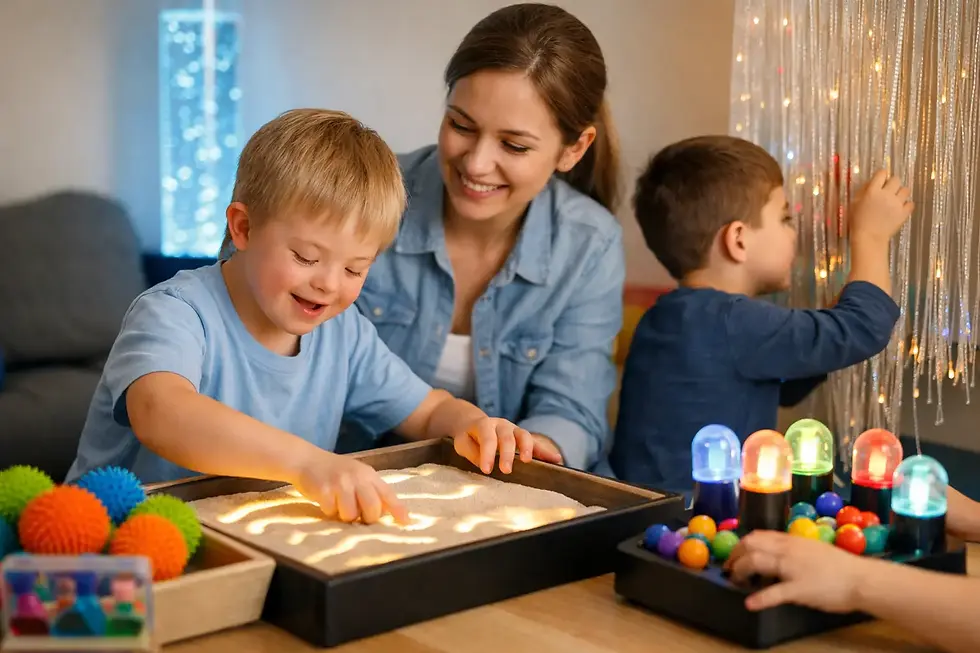
For organizations building more intentional sensory environments, this is where specialist guidance can be valuable. Teams often benefit from support that connects theory to room layout, equipment choices, staff training, and daily implementation. At Special Needs Toys Norway, that practical link between sensory knowledge and everyday pedagogy is central because the goal is not simply to add tools. It is to create settings where people can participate with dignity, safety, learning, and joy.
What are the eight different senses really teaching us?
They remind us that behavior is embodied. Every learner meets the world through a sensory system that shapes attention, comfort, movement, and connection. When professionals understand that, they tend to respond with more precision and more compassion.
A sensory-informed environment does not remove every challenge. It does something better. It gives children and adults a fairer starting point for success, regulation, and meaningful participation. That is often where real progress begins.


Comments